Saturday, July 19, 2014

Farnborough International Air Show

The Farnborough International Air Show is paired in alternate years with the Paris Air Show. In 2012, although stationed in England, I was away in Kazakhstan for a business trip, so this was my first opportunity to see this. Everyone who deals in the aerospace industry is here, from suppliers of tools and baggage carts to makers of satellites and weaponry. Many nations participate. I saw displays from Romania, Czech Republic, Turkey, Switzerland, Canada, Mexico, Africa, and of course the ever-present dominance of the mega industries from the United States, European Union, and Russia. I attended on the 18th of July against the backdrop of the downing of Malaysian Airlines Flight MH17 over Eastern Ukraine the day before by an apparent surface-to-air missile strike.

It was an eerie experience watching the animated demonstration in one of the Russian exhibits of what may have been the very system that downed the aircraft.


A nearby exhibit demonstrated a missile protection system that fired decoys from a plane to intercept incoming missiles. Some argue that Air Force One is protected; why shouldn't we be? Are we willing to pay for it or do we prefer to play the lottery?

The air show is walking distance from my apartment in Farnborough. I showed up early and beat the crowds, did all of the exhibits, went home for lunch and a brief nap, then came back for the flying displays. It was a rare, asphalt-melting day in England. With no sun screen (we don't need that in England, right?) I managed to come back with a very nice sunburn. But my choice of days to visit was a stroke of genius, as the next day turned out to be overcast and rainy.

Replica - The Original is in the Smithsonian
Here are some highlights:


A Turkish Helicopter - Really Bizarre

Hard to imagine how this monster EVER gets off the ground!

A Space Display from the Russians

Not exactly Camouflage, but then by the time you see it, it may already be too late


Drone displays were in evidence

Airbus A350 Cockpit Simulator
The "Fluor" building in the center background is where I work

Another Monster

The Harrier standing still in the air
The British "Red Arrows" Stunt Team


Transition Time Again

It's been such a long time since the last post.
Now its almost time to leave the UK experience behind. A lot of water under the bridge since the last post.....excursions to Dublin, Ireland, Edinburgh, Scotland (twice), a lovely trip to Germany in Christmas 2012, weekends in Dusseldorf/Osnabruck, Helsinki, New York. A home now in Houston (more to come on that). Memorable trips for family visits in Colorado, Texas, and now Oklahoma. Soon I'll leave work behind and start a new life of exploration. Some ideas are yet to mature and some may never, but they are sure to keep me active.

Sunday, November 11, 2012

Remembrance Day in the UK


At 11:00 0n the 11th day of the 11th month - an announcement at the Shopping Mall. An observance. Two minutes of silence. All across the UK, everyone stood still for two minutes to remember those who died in past conflicts. Some bowed their heads, perhaps they knew someone. A few, but not many, kept walking. Maybe apathy, perhaps open defiance. All-in-all, a rather touching moment for me, of course.

Every country has its remembrance days, but for some it perhaps means a bit more. The UK was involved from the beginning of WWI and WWII, in the midst of the European struggles of the times. The older generation experienced first hand the bombings and the shame of losing the initial battles. The U.S. was a late comer to both, at least in the European theater. We Americans honor our war dead on November 11. But we were not invaded. Hawaii was a territory, not a state. Yes, the attack was brutal, but occupation by the Japanese was never really a threat. To be invaded and occupied brings the horrors to a new level. Ask the Poles, the Chechs, and especially the Russians.

Is there more to come or are we ever going to end this slaughter of young men in the defense of our ideologies or bringing down despot leaders? Since WWII, we don't have wars anymore. At least we don't call them that. Korea, Viet Nam, the Balkans, Iraq, Afghanistan. All police actions. War was never formally declared. But soldiers and civilians died nonetheless. And we amass more arms so that some day we have the potential to destroy our entire planet.

As I observed the faces on this day, I had to ask myself - from the perspective of these people, is the glass half-full or half-empty? Not only from a war perspective, but about the quality of life in general. The British as a rule are rather conservative people, and, as a rule, not particularly out-going. Eye contact is rather rare. A few hearty welcomes when one starts a conversation, but in general quite a closed approach to strangers. I must say I'm rather reserved myself, but I do notice less outwardness from the British than from the Americans. Can one then jump to the generalization that these folks may think of the glass as half-empty? Here's what I think:

UK: Half-empty
US: Half-full
Russia: Half-empty
Germany: ??
Greece: Half-empty
Latin countries: Don't think about such things
Africa: Too busy surviving to think about it.
China: Must be half-full, but for how long?
Canada: Half-full (had to get another country on that side of the debate)

Thats my thought for the day.

Saturday, October 6, 2012

Edinburgh and the Scottish Highlands

Perhaps as close to the dream destination as I've been for some time. Relaxing, laid back, historical, entertaining. The center of the city is, of course, the Edinburgh Castle, prominent on the hill, visible from nearly all parts of the city. Scottish bagpipers (of all different ranges in talent), shops and markets. It didn't hurt to have some of the best days of weather of the year. Cool (even a bit cold) in the mornings, warm sunshine in the daytime.

The highlands - well, simply awesome. The first snow had come to the peaks, the highest in the British Isles. The geology: Northern Scotland is a part of the North American tectonic plate, separated from the European plate by the string of Lochs (lakes) running southwest to northeast across the center of Scotland. The lake to the northeast is the famous Loch Ness, of monster fame, which empties into the north sea. The other lakes enter the Atlantic ocean on the west. One bridge crossing during our journey took us ACROSS the Atlantic Ocean - proclaimed, rightly so, as the shortest Atlantic crossing on earth.

Highlands
The Village at Loch Ness


Loch Ness


Monday, August 27, 2012

Dublin, Ireland

A four day weekend in the UK. I've had it my mind for several years now to visit Ireland. After three nights of internet research, I settled on a route from London to Holyhead, Wales by train, then a ferry crossing to Dublin.

Due to the holiday weekend and a sailing regatta weekend in Dublin, hotel rooms were at a premium and terribly expensive. I finally found a B&B located a few miles north of the City Center and reserved for two nights through expedia.com. The next morning I had an e-mail from the proprietor saying they had accidentally double-booked the room for Saturday. He gave me the option of canceling or taking Friday night at no charge. I took the Friday night with hopes of locating accommodations for Saturday after I arrived in Dublin. I checked a number of places and found the cheapest room at around $200, which would have come to about $40 per one hour of sleep before I had to catch an early morning ferry     on Sunday. Being a budget traveller, I refuse to be extorted, so I decided to re-book my ferry for Saturday night, causing me to spend about 6 hours in the Holyhead ferry station waiting for the train back to London. I am no stranger to long lay-overs and quite adept at sleeping in an upright position in airports and railway stations all over the world, so the cost trade-off was acceptable.

My thoughts on Dublin (based on a 1-1/2 day walking tour):

1) Bars, bars and bars....and a few catholic churches.

2) Architecture not unique from anywhere else in Europe

3) Guiness Storehouse was a wonderful marketing production. Alfred Guiness signed a NINE-THOUSAND YEAR lease (around 45 pounds a year) when he bought the property. An amazing statistic.

4) Unique to this city from many of the others I've visited - PEOPLE NEED TO PICK UP AFTER THEIR DOGS. The rain turns this waste into a creamy mush on the sidewalks, a hazard that must be carefully stepped over.


Other facts:

The Guiness Book of Records was started in 1951 by Hugh Beaver, then managing director of the Guiness brewery, to enable bartenders in Dublin pubs in settling disputes of the who/what are the biggest, shortest, longest, deepest, fastest, etc of whatever the customers were arguing over.

Dublin is a writer's center, awarded numerous historic awards, and home to James Joyce, an early 20th century master, contemporary of Hemingway, T.S Eliot, and author of the classic novel Ulysses.

Walking tours are extremely challenging. The street names, when they are even seen, change from block to block. As in most European cities, the streets turn and veer off in different directions. I found myself heading south after starting out north more than a few times.

Would I go back?

A day in Dublin is plenty. A tour of the countryside would be worthwhile. Repeated visits not in my future itineraries.

Northern Wales is very scenic. A trip back may be worthwhile.


Fishing in Colorado

My brother has a piece of land near South Fork. Just east of the Wolf Creek ski area, near the banks of the Rio Grande and a short distance from numerous trout streams and mountain lakes. We enjoyed 3 days of summer fly fishing. We met a cousin who was vacationing there from the Baltimore, Maryland area. Other than a few casts a few years earlier, this was my first real introduction to fly fishing. The water was low and fishing was a bit sub-par, but we did have some luck in a few of the lakes. It was very relaxing and does interest me in pursuing the hobby a bit more. It helped that the weather was near-perfect. I don't know how well I would respond in less-than ideal weather. I am a sissy when the weather is cold. Tying those flies to my line is challenging even in the best of weather. My brother was very helpful and very understanding when I broke his rod (fortunately not the good one, which he had the foresight not to place it in my hands).


Sunday, June 17, 2012

Meeting With the Queen of England


Well, I didn't exactly 'meet' her and shake her hand, but the experience was interesting anyway, especially for an American who takes somewhat of a cynical view towards the power of royalty.

My Saturday was planned out. I was to take the train from Farnborough to London Waterloo station and walk across the Westminster Bridge to visit Churchill's Bunker. I would then grab a bite to eat and find one of four theatres which I had listed and see a live play.

I walked past the Parliament building and Big Ben and eventually found my bearings. When I found the sign to the war bunkers I noticed a barricade and a bobbie blocking the route. I thought I could go around so I kept walking to see if there was another access. Realizing that walk would lead me back over the River Thames, I turned around. The crowds were getting heavier, and I heard someone say there was to be a parade of some sort. My curiosity drove me thicker into the crowd. I heard a band playing a John Philip Sousa march, then came upon grandstands packed with people, with people off in the distance straining to get a view from the park. There was a band in the British Redcoat uniforms and mounted cavalry wearing high black fuzzy hats. So I put 2 and 2 together and surmised that this was a celebration of the victory in the War over the Falkland Islands, which had an anniversary the previous week and was all over the BBC. The Falkland dispute, twenty years back, was between England and Argentina over some small islands located off the eastern coast of Argentina, home to about a thousand or so British subjects and about 100,000 sheep. Anyway, I digress now....

I couldn't get close enough to see the ceremony, so I walked through the park back towards Trafalgar Square, still inching my way along. In about a half hour I was back in the Theatre district and spotted Her Majesty's Theatre, the venue for "Phantom of the Opera". I slipped inside and bought a ticket for the afternoon performance, then walked a block to St. James' pub and had lunch.

After lunch, I still had a few hours to kill before the matinee, so I thought I'd go see if there was any way I could still see the bunker, that perhaps the festivities were over and things had returned to normal.

Heading back to the mall, I saw that the band performance was over, and people were streaming out of the grandstand area and walking towards Buckingham Palace. What the heck, I've nothing but time to kill, so I joined them. There were more bobbie's, constables, men in tails and top hats than you can shake a stick at, but also normal folk, people wearing jeans and couples with baby strollers.

It was about a mile walk along the plaza to Buckingham Palace. At some point I discovered this event had nothing to do with the Falklands, but that it was in fact the Queen's Birthday. My goodness, that lady has been busy, The Diamond Jubilee had ended just the week prior, and the Queen was busy making appearances all over England to promote this or that charity, accepting flower bouquets and what not from blond little boys in blue school uniforms and little girls in braided pig tails. I digress again....

Everyone was queuing up outside the palace gates, but I found myself getting surprisingly close. I saw a purple banner folded over the second story balcony at the front of Buckingham Palace. Was the Queen actually going to make an appearance there? I started to get my answer when I heard a series of cannon shots that sounded like thunder. There were bobbie's on horses near to me and it was obvious the horses, while reacting, had become used to this and did not stampede into the crowd. Awesome, I thought.

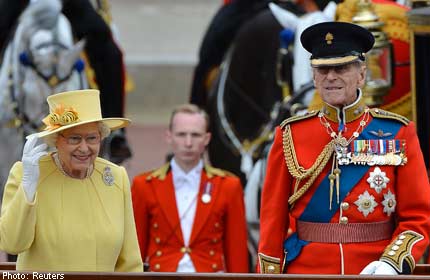
The cannon fire lasted about five minutes. A twenty-one gun salute, I presumed, although I wasn't counting. Then came the sound of trumpets. Something royal was happening. The crowd's excitement grew. I heard a cheer arise from the crowd. They were all staring up at the balcony. I saw the door open leading out to the balcony, and out comes this little lady in a bright yellow dress and yellow hat (how many of these outfits does she have, do you presume). This was Queen Elizabeth II, ruler of the British Empire, sovereign of the British Commonwealth. Prince Philip, still looking dapper at the grand age of 91, was alongside her, dressed in a bright red jacket with medals pinned on his chest, and a blue military hat. They stood at the balcony, and were followed out shortly by Prince Charles and Camilla, then Prince William and Kate (they got the loudest cheers - extremely popular, it seems), then a half dozen more folks I couldn't identify.
QE II with Prince Phillip (not my photo - I didn't have the camera)

After the crowd had settled down, there came the sound of helicopters. Four of them flew in formation over the crowd and over Buckingham Palace. They were followed by a formation of four 60's era propeller planes, the largest in the center, perhaps a B-52 bomber. After that some faster jets, in a formation of four, then the climax - fighter jets emitting red, white and blue exhaust, also flying directly over the crowd and over the queen's balcony.

The queen and the other folks waved a few more times, then retreated back inside the palace. The festivities ended, the crowd dispersed, I was thirsty, so I headed for the nearest pub for another pint of London's finest before moving on to my matinee.

Sunday, June 10, 2012

It's been a while. I'm in London now. Well, Farnborough actually. A small suburban community about 30 miles from Central London. I've been on sabbatical from blogging, but starting to get a bit more inspired. Perhaps this will get me going again. I missed the queen's Diamond Jubilee by one weekend (business trip in Kazakhstan), but I managed to get into London the next weekend. Its really a humming place. I'm still getting the feel of the place, went on a book hunting expedition through Soho. Walked through the theatre district. Wow, about 200 plays and musicals to choose from. All the big ones - Les Miserable, Phantom, Lion King. Just name it. A pub on every corner. Yes, I did come back with about 6 books.


Tuesday, July 5, 2011

The 4th of July and the state of America

Independence Day in the United States. For me, it comes and goes with little fanfare. I'm spending my day relaxing in my air-conditioned Pasadena apartment, catching up on a few phone calls and doing a bit of surfing on the internet. I turned on CNN, mainly for a bit of background noise. I don't watch CNN much anymore, nor do I watch much news on television at all. Not much news anymore, really, seems like more show business and such. However, when I turned it on, something touched a nerve with me. Something close to my heart.

I never gave this much thought either, but, as it turns out, July 4th is a traditional day for administering the oath of citizenship to newly-naturalized U.S. Citizens. CNN was running a segment showing immigrants taking the oath, and interviewing those who had just taken it. The country of origins were places like Lebanon, Cuba, Mexico, Indonesia and more. And yes, there was one Mexican immigrant who swam across the Rio Grande 40 years ago because “it was the only hope I had for a better life”.

When asked why they wanted to become U.S. Citizens, the responses from the immigrants fell into two categories:

  1. For the most part, hard work and merit pays off in this country. In their country, class, religious affiliation and political connections lead to discrimination, and hard work and merit are not always the pathway to success.
  2. This country's tradition of tolerance to different societies, religions and social customs.

And further to the second point, one man expressed the opinion that “Intolerance is what can bring this country down.”

I'm a naturalized immigrant. My family moved to the U.S. In 1960 when I was six years old. We were sponsored by my dad's cousin, who had immigrated with her husband from Ukraine by way of a post- World War II refugee camp in Germany. My dad's cousin was sponsored by her grandfather, who had immigrated from Ukraine in the early 20th century, about one hundred years ago. We were poor, but I don't dwell on that, mainly because I had no idea then that we were. My dad worked as a mechanic, then as a construction worker, then in a factory woodshop until he retired. He had a 4th grade education. The communists closed the German schools in Ukraine, and my dad's Russian wasn't good enough to attend the Russian schools. Besides, there weren't enough teachers anyway. My dad's father and grandfather were very successful in Ukraine, until the communists confiscated their property, sent them to prison, and eventually executed them, leaving my dad an orphan. As for my mother, she helped out by cleaning houses and then landed a job in the school cafeteria. We were latch-key kids, but again, we had no idea what that meant either.

My parents brought three sons to the U.S., and had another in this country. All four of us earned college degrees. We all worked our way through school and, with the exception of my older brother, who received his degree with assistance through the G.I. Bill after a tour in Viet Nam, we all did it without financial support.

I have lived and worked in a number of different countries and cultures – Germany, Thailand, Indonesia, Kazakhstan, Russia, Venezuela, Puerto Rico. And different cultures within the U.S - Texas, Colorado, Nebraska, California, Washington, West Virginia. As Californians will attest, even the cultures of Southern and Northern California differ materially to the close observer. So why are we as a country, through our political and religious institutions, suddenly proclaiming that this American culture should be preserved in a static condition, immigration be halted, English be legislated as the only language, and religious freedom stifled. Has someone, un-beknownst to me, managed to define the “American culture” as some form of english-speaking Anglo-European, Christian society? If so, how tragic. I thought about this as I enjoyed my lunch at a local Mexican restaurant, with clientele consisting of Chinese, Thai, Mexican, Blacks and, oh yes Anglo-Europeans. Later I went to my local supermarket to pick up ingredients for the stir-fry I would make for dinner. In my apartment in Pasadena, it's very normal to hear someone coming out of the elevator speaking a language I don't understand. I don't give it a second thought anymore.

Every culture has contributed to this country's development. The early English settlers may not have survived without the help they received from the native Indians, only to later confiscate the Indian's lands and, when the Indians protested, annihilating them, often in the name of religion - for the Pagan Indians did not worship the proper God. Were it not for the French, the Revolutionary War may not have succeeded. Later came the Irish, the Italians, the Germans, the Greeks, the Scandinavians, the Eastern Europeans, And let's not forget the Africans, who came here only after a bit of “persuasion”. The Spanish, Chinese and Japanese played a prominent role in the development of the Western U.S., and the Russians were kind enough to sell us Alaska (not the most popular decision at the time).

I'm not a flag-waving patriot. I'm disturbed with the underlying propaganda messages we receive on days like this, and throughout the year. We do have problems in this country, and we cannot claim we have equality. But we do retain hope. And the reason we do, while the idea started with the founders of this country and the language they put into the Declaration of Independence, is largely due to the hundreds of millions of immigrants that came later.

The lesson in this: Intolerance will never work. Stifling cultural, religious and language differences will meet with resistance and frustration, and will make our society weaker. Remain tolerant, accept differences, foster dialogue, keep hope alive. That will keep this country strong.

Monday, May 30, 2011

Ruski Days - Keep it Going

I couldn't decide what to do with this blog now that I've left Russia. Should I call it California Days or Texas days or wherever-I-am-next days? What's the purpose? This blog is about the human spirit, the desire to travel and experience new ways and cultures. Nothing related to a specific place, but rather a state of mind I've tried to create to deal with my own journey inside this washing machine we call life. I've decided to keep this blog alive. It will feature photos of whatever I please, anecdotes, recipes, stories and more.

Here is the first: Judge how you may, I don't do this for a living, so I don't need to please the critics.


The Race

I look deep down where my emotions dwell
Happy at times and melancholy as well

Now I might ask – what do I need?
Is it energy, spark, the drive to succeed?

For the answer, look both ways, my friends
For there you may find the means to amends

Look to the past, where your forefathers dwell
Look to the future, where only time will tell.

Its not the here, not the there, not the somewhere out there
Satisfaction comes from the just getting there.

Its not the beginning, its not the end, its the race my friend
Its the race that we endure, that makes us happy and mature.

Tuesday, March 22, 2011

Final Days

I had wandered long and far, when I came upon that great land of the north
Its many wonders there to behold.

Have I seen it, some did ask; have I seen the great monastaries
The banyas, the endless forests and awesome steppes, the great rivers.

And I asked myself, within this searching soul, what had I seen and what had I not
For to some, it seems, I had not seen nearly enough

The answer, once again, lies within my soul.
For what I have seen goes far beyond my eyes.

I had seen it as a child, my friend, within my father's eyes, within this parallel universe we exist
And I saw it again, those ghosts on the subway, strollers on the Ploschad, shoppers at the mart.

The faces of the children, and the friends I now behold.
This great land is seen not only with the eyes, fellow wanderer

It is seen also with the heart.

Monday, December 27, 2010

Winter in Moscow

Sort of reminds me of something similar to what Dickens once said. Its the best of times, its the worst of times. The season is festive, and Muscovites adore snow and cold. It comes with their history. Napoleon and Hitler both confronted "General Winter" and were soundly defeated. But no doubt winter here has its challenges. The constant brown mush on the streets, slippery sidewalks and the short days help to explain why every Muscovite who can afford it heads for the tropics around the New Year's Holidays. Moscow's businesses shut down from the first until the 11th.

On Christmas Day, I ventured down to Red Square, to see the lights and watch the skaters. I had given some thought to strapping on a pair of skates myself, but when I surfaced from the depths of the Moscow subway, I discovered that the temperature had risen to near freezing and the city was being pummeled with a steady sleet. Four hours later, the temperature dropped again and the surfaces froze solid. Walking became a real challenge (maybe I should strap those skates on now!) The next morning, I awoke to the sounds of snapping tree branches and the ping, ping of people with their ice scrapers trying to get an inch of ice off their car's windshields. It was incredible. If the car had snow on it before, that was now ice. One person at work said it took him 30 minutes, after a series of hot water buckets, to even get his car door open. Domodedevo airport lost power, as did 300 surrounding villages. The sidewalks were littered with tree branches.

I have never seen a city so under control after a major storm. Snow removal here is handled primarily by migrant workers. They come here from Uzbekistan, Krgystan, Azerbijaan, and other republics down south, where work in the winter is hard to come by, and get handed a snow shovel. Its good money. Like the US migrants that harvest our crops. 24/7 I hear the snow shovels going. They shovel into piles, then a backhoe loader comes and puts it in a dump truck and hauls it to the Moscow River. It snows about 8 days out of 10, but the sidewalks and streets stay accessible. Oh yes. whatever you do, do NOT walk too close to a building. The buildings in the business districts abut up to the sidewalk. Ice falling from 4 and 6 story buildings kills a dozen or so every year. Yes, they shovel there too, but nothing is 100% guaranteed!!

 View from my apartment on the 6th floor


                                                             Dogs like it
Building heat and hot water supply comes from a central facility via underground piping.


                                                  The route to the metro (subway)
 Red Square on Christmas Day


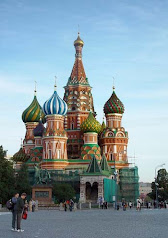
                        St. Basil's Cathedral on Red Square

Sunday, October 17, 2010

Russian Museum of Modern History

Here I go again. Museums and history. Well, I just can't help myself. I was trying to find a bookstore I knew to have some English selections. I couldn't locate the street, but I knew it was just off Tverskaya Ulitsa near the Mayakovskaya Metro Station. The transfer station at Belloruskaya was closed for repairs, and I couldn't quite get to Mayakovskaya, so I decided to walk the final distance. Having passed Mayakovskaya and the Tchaikovsky Theatre, I still couldn't locate the street with my bookstore. It was around freezing and my fingers were getting cold as I passed the Museum of Russian modern history. I had passed it many times and it was on my list of places to see. This was a perfect opportunity.

World War I Tank
Inside the Lobby
These museums never have huge banners and grand entrances. Its more like walking into an apartment building. After reading the sign and determining that the museum was open until 7:00 pm (it was 4:00), I decided to venture inside. After walking through a security detector, my eyes scanned the lobby past several police guards towards the back entrance and finally the cashier's cage on my left. There was no line, and in fact, not many people. I was surprised to see the cost of admission to be only 100 rubles (about $3.50), but for around $50 I could have an english interpreter. Now, what fun would that be? I can read enough Russian to do this myself! Save the $50 for a cup of Starbuck's later !!

The museum was much, much larger than I had ever expected. After getting through endless exhibits of 19th century village life, the Russo-Japanese War of 1905 (they totally got their butts kicked in that one, but it didn't come across that way at all), and finally towards World War I, I was wondering when we get to the good stuff. That is, I really wanted to see the Bolshevik Revolution, followed by the Stalin repressions, then on to the Great Patriotic War (The Russian term for WWII). Much of what is fascinating about Russian History is that it was re-written many times during the communist era. The government had full censorship capability and was able to choose what or who to add or take away from the historical records. In short, they had the ability to change history, and they took full advantage. I was really wondering how they would treat the Stalin "crimes", as confessed later by Kruschev after Stalin's death. While I did see some of Lenin's pictures and a few busts, and then a lot of Stalin, any slant towards opinion or commentary was totally absent. The pre-war years (1932-1937), the times of the great terror, weren't presented as a topic. Only if you read between the lines and really looked at the photos, by seeing how times were hard, could you start to imagine it. But no pictures of the gulags. Wouldn't that be something. When will someone open a museum about the Gulags.


The pictures of Stalin with his military commanders, with Roosevelt and Churchill at Potsdam, of his funeral procession, the parades on red square, the banners and slogans of the communist party, they all bring back memories of newsreels I watched in America as a child and young adult. We still see these events in China (although not as often these days), and probably most pronounced now in North Korea, that last vestige of absolute communist control. I still wonder if Stalin ever considered a more humanitarian approach to his reforms. I believe some of his inner circle did, but they obviously did not make the decisions, and also ran the risk of being sent to the Gulag, or worse, for dissenting too enthusiastically. I found it interesting the KGB, and its predecessor NKVD, were not mentioned. I will check again, but it certainly appeared they have been removed from this historical display.


Finally, a section devoted to modernization, something Stalin, somewhat inspired by the needs of WWII (not unlike the economic engine unleashed in America at the same time), was quite successful at, then followed by Kruschev, who at one time told the Americans "we will bury you", referring to the monumental economic growth in the USSR at the time. There was even a chart, used for propaganda, showing the growth rate of America vs. the (projected) rate of the USSR, and emphasizing, perhaps with a few tricks of the scale I'm not totally unfamiliar with in my line of work, and which you see on many of Wall Street's economic charts today, whose purpose was to convince the world of Russia's economic might, and perhaps even put a little scare into the Americans. If that didn't scare us, then the next exhibits portraying the space race certainly did. Sputnik, the first dog in space, the first man in space. Russia seemingly was pulling ahead, which prompted John F. Kennedy to make his famous declaration, that America "before the end of this decade (the 60s) would land, and safely return, a man on the moon".

But Russia, while pulling ahead in the space race, and possibly even the arms race, neglected their domestic economy (despite what the chart might have said). Housing was in short supply and decrepit, consumer supplies (cars, refrigerators, meat, toilet paper) were inferior or not available to the general public. Following the years of stagnation under Brezhnev, followed by two insignificant figureheads in Chernenko and Andropov, change began to happen under Gorbachev. Demand for change was so pent up that, once the genie came out of the bottle, it would not go back in. It raced now out of control. The Baltic Republics, Western Europe, the Berlin Wall, Chernobil, and finally the dissolution of the Soviet Union and the emergence of Boris Yeltsin and the destruction of all things communist. It happened so fast, if one slept in on Sunday, one may have missed a significant event.

So here we are today. From a westerner's perspective, there are times I wonder if Russia isn't more capitalistic now than many Western European countries, and perhaps even than the U.S., now that Obama has stepped in and allowed the government to control our banking industry and even make our largest car company a government entity. (Can you believe it, the government now manufactures automobiles in the U.S.).
Total capitalism isn't the answer in Russia, as seen by the emergence of the oligarchs and other elements of the Russian mafia, and certainly total socialism isn't the answer in Europe or the U.S. As a people, we eternally strive for the special "Goldilocks" solution. Not too much, not too little, but just right. The pendulum swings both ways, and winds change. Perhaps that's what makes life, and history, so interesting.


Russian capitalism on display. The bronze and silver paint job on this BMW in downtown Moscow must've cost a few rubles.


Wednesday, October 13, 2010

I'm Baa...aack

I had no idea if I would ever get back to Russia or not. Job prospects did not look good, and assignments would take me to other unknown places. I accepted an assignment in Calgary, Canada, only to find out days before starting that the client had changed his mind and was going in a different direction. Just after that one cancelled, a call came in asking if I'd be interested in an assignment in Moscow, then moving on to Tobolsk, in western Siberia. Assignments don't pop up at me anymore, and, having had some prior experience with Russian clients, I decided to accept. Maybe this will be my swan song, if it lasts. After this I'll teach, write and maybe take up fishing.

From My Balcony
WWII War Memorials at Red Square
So here I am in Moscow, working in the client's office, my own apartment within walking distance, but only minutes away from anyplace in the city via the subway.

Winter isn't far off so I'll try to enjoy what little good weather is left.
Entrance to Red Square; Russian State Museum
Must we have McDonald's EVERYwhere? Then again, isn't that what set them on the road to capitalism?

Monday, May 31, 2010

Back to Nizhnekamsk

It was a very exciting two weeks. First St. Petersburg, then my long-awaited trip to Ukraine. Getting back into Domodedova airport felt like coming home. The airport here is light-years ahead of Kiev and Odessa, and I feel perfectly comfortable. I breeze through customs and, with two hours to kill, head for my usual airport spot, Krotscka-Kartochka, for a baked potato and a Starri Melnuuk piva, then sit down and try to finish the novel I've been reading during the waiting times on my trip. I'm about to get on my eighth flight in two weeks, with seven hotel stays in between. I'm on my last clean set of clothes (one set of laundry done n Kiev), and those are quite sweaty from the day in Kiev.
The ride from Nizhnekamsk airport to my apartment was rather interesting. The main road is closed for repairs, so we took a detour. We went through dirt roads in the middle of nowhere, and my kidneys were feeling it. For a while I thought they were going to dump me out in the boonies. When we finally got back on the main road, there was absolutely no traffic. The main road is usually busy with traffic between Nizhnekamsk and Naborezhny Chelny, but with this detour, no one seemed to want to risk their suspension. I found out the next day the road repair was necessitated by the fact that the president of Russia, Medvedev, is coming in for a visit on Saturday. The city and the job site is undergoing a major facelift in honor of his visit.