Sort of reminds me of something similar to what Dickens once said. Its the best of times, its the worst of times. The season is festive, and Muscovites adore snow and cold. It comes with their history. Napoleon and Hitler both confronted "General Winter" and were soundly defeated. But no doubt winter here has its challenges. The constant brown mush on the streets, slippery sidewalks and the short days help to explain why every Muscovite who can afford it heads for the tropics around the New Year's Holidays. Moscow's businesses shut down from the first until the 11th.
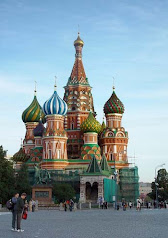
On Christmas Day, I ventured down to Red Square, to see the lights and watch the skaters. I had given some thought to strapping on a pair of skates myself, but when I surfaced from the depths of the Moscow subway, I discovered that the temperature had risen to near freezing and the city was being pummeled with a steady sleet. Four hours later, the temperature dropped again and the surfaces froze solid. Walking became a real challenge (maybe I should strap those skates on now!) The next morning, I awoke to the sounds of snapping tree branches and the ping, ping of people with their ice scrapers trying to get an inch of ice off their car's windshields. It was incredible. If the car had snow on it before, that was now ice. One person at work said it took him 30 minutes, after a series of hot water buckets, to even get his car door open. Domodedevo airport lost power, as did 300 surrounding villages. The sidewalks were littered with tree branches.
I have never seen a city so under control after a major storm. Snow removal here is handled primarily by migrant workers. They come here from Uzbekistan, Krgystan, Azerbijaan, and other republics down south, where work in the winter is hard to come by, and get handed a snow shovel. Its good money. Like the US migrants that harvest our crops. 24/7 I hear the snow shovels going. They shovel into piles, then a backhoe loader comes and puts it in a dump truck and hauls it to the Moscow River. It snows about 8 days out of 10, but the sidewalks and streets stay accessible. Oh yes. whatever you do, do NOT walk too close to a building. The buildings in the business districts abut up to the sidewalk. Ice falling from 4 and 6 story buildings kills a dozen or so every year. Yes, they shovel there too, but nothing is 100% guaranteed!!
View from my apartment on the 6th floor
Dogs like it
Building heat and hot water supply comes from a central facility via underground piping.
The route to the metro (subway)
Red Square on Christmas Day
St. Basil's Cathedral on Red Square
Monday, December 27, 2010
Sunday, October 17, 2010
Russian Museum of Modern History
Here I go again. Museums and history. Well, I just can't help myself. I was trying to find a bookstore I knew to have some English selections. I couldn't locate the street, but I knew it was just off Tverskaya Ulitsa near the Mayakovskaya Metro Station. The transfer station at Belloruskaya was closed for repairs, and I couldn't quite get to Mayakovskaya, so I decided to walk the final distance. Having passed Mayakovskaya and the Tchaikovsky Theatre, I still couldn't locate the street with my bookstore. It was around freezing and my fingers were getting cold as I passed the Museum of Russian modern history. I had passed it many times and it was on my list of places to see. This was a perfect opportunity.
These museums never have huge banners and grand entrances. Its more like walking into an apartment building. After reading the sign and determining that the museum was open until 7:00 pm (it was 4:00), I decided to venture inside. After walking through a security detector, my eyes scanned the lobby past several police guards towards the back entrance and finally the cashier's cage on my left. There was no line, and in fact, not many people. I was surprised to see the cost of admission to be only 100 rubles (about $3.50), but for around $50 I could have an english interpreter. Now, what fun would that be? I can read enough Russian to do this myself! Save the $50 for a cup of Starbuck's later !!
The museum was much, much larger than I had ever expected. After getting through endless exhibits of 19th century village life, the Russo-Japanese War of 1905 (they totally got their butts kicked in that one, but it didn't come across that way at all), and finally towards World War I, I was wondering when we get to the good stuff. That is, I really wanted to see the Bolshevik Revolution, followed by the Stalin repressions, then on to the Great Patriotic War (The Russian term for WWII). Much of what is fascinating about Russian History is that it was re-written many times during the communist era. The government had full censorship capability and was able to choose what or who to add or take away from the historical records. In short, they had the ability to change history, and they took full advantage. I was really wondering how they would treat the Stalin "crimes", as confessed later by Kruschev after Stalin's death. While I did see some of Lenin's pictures and a few busts, and then a lot of Stalin, any slant towards opinion or commentary was totally absent. The pre-war years (1932-1937), the times of the great terror, weren't presented as a topic. Only if you read between the lines and really looked at the photos, by seeing how times were hard, could you start to imagine it. But no pictures of the gulags. Wouldn't that be something. When will someone open a museum about the Gulags.

The pictures of Stalin with his military commanders, with Roosevelt and Churchill at Potsdam, of his funeral procession, the parades on red square, the banners and slogans of the communist party, they all bring back memories of newsreels I watched in America as a child and young adult. We still see these events in China (although not as often these days), and probably most pronounced now in North Korea, that last vestige of absolute communist control. I still wonder if Stalin ever considered a more humanitarian approach to his reforms. I believe some of his inner circle did, but they obviously did not make the decisions, and also ran the risk of being sent to the Gulag, or worse, for dissenting too enthusiastically. I found it interesting the KGB, and its predecessor NKVD, were not mentioned. I will check again, but it certainly appeared they have been removed from this historical display.
Finally, a section devoted to modernization, something Stalin, somewhat inspired by the needs of WWII (not unlike the economic engine unleashed in America at the same time), was quite successful at, then followed by Kruschev, who at one time told the Americans "we will bury you", referring to the monumental economic growth in the USSR at the time. There was even a chart, used for propaganda, showing the growth rate of America vs. the (projected) rate of the USSR, and emphasizing, perhaps with a few tricks of the scale I'm not totally unfamiliar with in my line of work, and which you see on many of Wall Street's economic charts today, whose purpose was to convince the world of Russia's economic might, and perhaps even put a little scare into the Americans. If that didn't scare us, then the next exhibits portraying the space race certainly did. Sputnik, the first dog in space, the first man in space. Russia seemingly was pulling ahead, which prompted John F. Kennedy to make his famous declaration, that America "before the end of this decade (the 60s) would land, and safely return, a man on the moon".
But Russia, while pulling ahead in the space race, and possibly even the arms race, neglected their domestic economy (despite what the chart might have said). Housing was in short supply and decrepit, consumer supplies (cars, refrigerators, meat, toilet paper) were inferior or not available to the general public. Following the years of stagnation under Brezhnev, followed by two insignificant figureheads in Chernenko and Andropov, change began to happen under Gorbachev. Demand for change was so pent up that, once the genie came out of the bottle, it would not go back in. It raced now out of control. The Baltic Republics, Western Europe, the Berlin Wall, Chernobil, and finally the dissolution of the Soviet Union and the emergence of Boris Yeltsin and the destruction of all things communist. It happened so fast, if one slept in on Sunday, one may have missed a significant event.
So here we are today. From a westerner's perspective, there are times I wonder if Russia isn't more capitalistic now than many Western European countries, and perhaps even than the U.S., now that Obama has stepped in and allowed the government to control our banking industry and even make our largest car company a government entity. (Can you believe it, the government now manufactures automobiles in the U.S.).
Total capitalism isn't the answer in Russia, as seen by the emergence of the oligarchs and other elements of the Russian mafia, and certainly total socialism isn't the answer in Europe or the U.S. As a people, we eternally strive for the special "Goldilocks" solution. Not too much, not too little, but just right. The pendulum swings both ways, and winds change. Perhaps that's what makes life, and history, so interesting.
Russian capitalism on display. The bronze and silver paint job on this BMW in downtown Moscow must've cost a few rubles.
![]() |
| World War I Tank |
![]() |
| Inside the Lobby |
The museum was much, much larger than I had ever expected. After getting through endless exhibits of 19th century village life, the Russo-Japanese War of 1905 (they totally got their butts kicked in that one, but it didn't come across that way at all), and finally towards World War I, I was wondering when we get to the good stuff. That is, I really wanted to see the Bolshevik Revolution, followed by the Stalin repressions, then on to the Great Patriotic War (The Russian term for WWII). Much of what is fascinating about Russian History is that it was re-written many times during the communist era. The government had full censorship capability and was able to choose what or who to add or take away from the historical records. In short, they had the ability to change history, and they took full advantage. I was really wondering how they would treat the Stalin "crimes", as confessed later by Kruschev after Stalin's death. While I did see some of Lenin's pictures and a few busts, and then a lot of Stalin, any slant towards opinion or commentary was totally absent. The pre-war years (1932-1937), the times of the great terror, weren't presented as a topic. Only if you read between the lines and really looked at the photos, by seeing how times were hard, could you start to imagine it. But no pictures of the gulags. Wouldn't that be something. When will someone open a museum about the Gulags.

The pictures of Stalin with his military commanders, with Roosevelt and Churchill at Potsdam, of his funeral procession, the parades on red square, the banners and slogans of the communist party, they all bring back memories of newsreels I watched in America as a child and young adult. We still see these events in China (although not as often these days), and probably most pronounced now in North Korea, that last vestige of absolute communist control. I still wonder if Stalin ever considered a more humanitarian approach to his reforms. I believe some of his inner circle did, but they obviously did not make the decisions, and also ran the risk of being sent to the Gulag, or worse, for dissenting too enthusiastically. I found it interesting the KGB, and its predecessor NKVD, were not mentioned. I will check again, but it certainly appeared they have been removed from this historical display.
Finally, a section devoted to modernization, something Stalin, somewhat inspired by the needs of WWII (not unlike the economic engine unleashed in America at the same time), was quite successful at, then followed by Kruschev, who at one time told the Americans "we will bury you", referring to the monumental economic growth in the USSR at the time. There was even a chart, used for propaganda, showing the growth rate of America vs. the (projected) rate of the USSR, and emphasizing, perhaps with a few tricks of the scale I'm not totally unfamiliar with in my line of work, and which you see on many of Wall Street's economic charts today, whose purpose was to convince the world of Russia's economic might, and perhaps even put a little scare into the Americans. If that didn't scare us, then the next exhibits portraying the space race certainly did. Sputnik, the first dog in space, the first man in space. Russia seemingly was pulling ahead, which prompted John F. Kennedy to make his famous declaration, that America "before the end of this decade (the 60s) would land, and safely return, a man on the moon".
But Russia, while pulling ahead in the space race, and possibly even the arms race, neglected their domestic economy (despite what the chart might have said). Housing was in short supply and decrepit, consumer supplies (cars, refrigerators, meat, toilet paper) were inferior or not available to the general public. Following the years of stagnation under Brezhnev, followed by two insignificant figureheads in Chernenko and Andropov, change began to happen under Gorbachev. Demand for change was so pent up that, once the genie came out of the bottle, it would not go back in. It raced now out of control. The Baltic Republics, Western Europe, the Berlin Wall, Chernobil, and finally the dissolution of the Soviet Union and the emergence of Boris Yeltsin and the destruction of all things communist. It happened so fast, if one slept in on Sunday, one may have missed a significant event.
So here we are today. From a westerner's perspective, there are times I wonder if Russia isn't more capitalistic now than many Western European countries, and perhaps even than the U.S., now that Obama has stepped in and allowed the government to control our banking industry and even make our largest car company a government entity. (Can you believe it, the government now manufactures automobiles in the U.S.).
Total capitalism isn't the answer in Russia, as seen by the emergence of the oligarchs and other elements of the Russian mafia, and certainly total socialism isn't the answer in Europe or the U.S. As a people, we eternally strive for the special "Goldilocks" solution. Not too much, not too little, but just right. The pendulum swings both ways, and winds change. Perhaps that's what makes life, and history, so interesting.
Russian capitalism on display. The bronze and silver paint job on this BMW in downtown Moscow must've cost a few rubles.
Wednesday, October 13, 2010
I'm Baa...aack
I had no idea if I would ever get back to Russia or not. Job prospects did not look good, and assignments would take me to other unknown places. I accepted an assignment in Calgary, Canada, only to find out days before starting that the client had changed his mind and was going in a different direction. Just after that one cancelled, a call came in asking if I'd be interested in an assignment in Moscow, then moving on to Tobolsk, in western Siberia. Assignments don't pop up at me anymore, and, having had some prior experience with Russian clients, I decided to accept. Maybe this will be my swan song, if it lasts. After this I'll teach, write and maybe take up fishing.
So here I am in Moscow, working in the client's office, my own apartment within walking distance, but only minutes away from anyplace in the city via the subway.
Winter isn't far off so I'll try to enjoy what little good weather is left.
![]() |
| From My Balcony |
![]() |
| WWII War Memorials at Red Square |
Winter isn't far off so I'll try to enjoy what little good weather is left.
![]() |
| Entrance to Red Square; Russian State Museum |
![]() |
| Must we have McDonald's EVERYwhere? Then again, isn't that what set them on the road to capitalism? |
Monday, May 31, 2010
Back to Nizhnekamsk
It was a very exciting two weeks. First St. Petersburg, then my long-awaited trip to Ukraine. Getting back into Domodedova airport felt like coming home. The airport here is light-years ahead of Kiev and Odessa, and I feel perfectly comfortable. I breeze through customs and, with two hours to kill, head for my usual airport spot, Krotscka-Kartochka, for a baked potato and a Starri Melnuuk piva, then sit down and try to finish the novel I've been reading during the waiting times on my trip. I'm about to get on my eighth flight in two weeks, with seven hotel stays in between. I'm on my last clean set of clothes (one set of laundry done n Kiev), and those are quite sweaty from the day in Kiev.
The ride from Nizhnekamsk airport to my apartment was rather interesting. The main road is closed for repairs, so we took a detour. We went through dirt roads in the middle of nowhere, and my kidneys were feeling it. For a while I thought they were going to dump me out in the boonies. When we finally got back on the main road, there was absolutely no traffic. The main road is usually busy with traffic between Nizhnekamsk and Naborezhny Chelny, but with this detour, no one seemed to want to risk their suspension. I found out the next day the road repair was necessitated by the fact that the president of Russia, Medvedev, is coming in for a visit on Saturday. The city and the job site is undergoing a major facelift in honor of his visit.
Thursday, May 27, 2010
Worms (Vinogradne), Ukraine
The Rohrbach trip was finally fulfilled. First we went to Worms, now Vinogradne, a very usual Ukrainian village, a right hand turn off the main road. We were met by an elderly lady at the local orthodox church, the church having been converted from a Lutheran church after the Germans left. What was interesting was that she still spoke German, and told us "I wish you folks would come more often so I can practice my German." She remembered a lot of the old German houses and folks there, but I'm sure she had to be very young when the Germans bolted back to Germany.
The old lady, our local contact, is front and center. Rest of the folks all have ancestors in Worms or Rohrbach.
Sunday, May 23, 2010
Odessa, Ukraine - Trip to the Homeland
When I took this assignment in Russia, one of the things in the back of my mind was that it might afford me the opportunity to take that long-awaited trip to Odessa and the nearby German colonies, where my family heritage stems from on my father's side. You may have noticed, on occasion, a reference to another blogspot which I maintain, called There and Back
At this point, the two sites have intersected at a common space and time.
Odessa - Pearl of the Black Sea. A city commissioned by Catherine the Great after driving the Turks out of Ukraine and claiming it as New Russia, also creating the need to colonize the southern part of Ukraine. That led to the manifesto inviting German settlers to the area. Well, this site isn't about history. I'll leave that to There and Back.

In its time, Odessa was probably the most ethnically-diverse city on the planet. The harbor was designed by a dutch engineer, the traders were Greek (the name odessa is a derivative of the Greek goddess Odysseus), merchants from all over did business in the port. The man probably most responsible for its early success was the Duc de Richelieu, the Frenchman who was appointed governor. The early architecture, still visible, represents a wide array of styles. My hotel is a restored Victorian mansion. The story is Trotsky used to stay there on his visits to Odessa.
At this point, the two sites have intersected at a common space and time.
Odessa - Pearl of the Black Sea. A city commissioned by Catherine the Great after driving the Turks out of Ukraine and claiming it as New Russia, also creating the need to colonize the southern part of Ukraine. That led to the manifesto inviting German settlers to the area. Well, this site isn't about history. I'll leave that to There and Back.

In its time, Odessa was probably the most ethnically-diverse city on the planet. The harbor was designed by a dutch engineer, the traders were Greek (the name odessa is a derivative of the Greek goddess Odysseus), merchants from all over did business in the port. The man probably most responsible for its early success was the Duc de Richelieu, the Frenchman who was appointed governor. The early architecture, still visible, represents a wide array of styles. My hotel is a restored Victorian mansion. The story is Trotsky used to stay there on his visits to Odessa.Friday, May 21, 2010
Zelyenni Borsch in the Coffee Shop
Its my last day in Kiev. My checkout time from the hotel is 12:00 and my flight isn't until 10:20 at night. Don't like getting in that late, but that's the only flight. Since I'm up at 5:00 am, I check to see if there might be time to hop on a train. It only costs about $20. Turns out the train travels at night, so I missed that. Now I have some time to kill. Before I check out of the hotel, I walk around the neighborhood a bit to see if there's any internet cafes. I can hang out in the hotel lobby, where I have already purchased a wi-fi card, but 8 hours is still a long time to hang out in a hotel lobby. I casually stroll through a local shopping mall, where I find a really neat beer mug, made from hardwood with a stainless steel inlay and pewter emblems of a cossack and coat-of arms on the outside. I can't resist; just hope it survives all of the suitcases later on.
After checking out of the hotel, I finish up a couple of posts, and then, with bags in tow, head to a patio restaurant about a block away to get lunch. I see they have Ukrainskii borsch, and order some. It is very tasty, but red! Not the green (zelyenni) I've been looking for. It does have a similar flavor to the green, so I'm somewhat ok with this. But where is the green borsch? I had looked for it the day before, and settled for some solyanka - a potato, meat flavored hearty soup - also very tasty. I highly recommend it as well. But I'm still looking for my Zelyenni. I head back to the hotel for another hour and poke around on the internet, then decide to head to a local coffee house, named Chaikoff, for a cup of that delicious European coffee. I'm going there because they showed a sign indicating free wi-fi. That's where I am now. Its one of those trendy places where folks hang out talking and drinking coffee. Checking their menu, they serve a full lunch, not just coffee. (As an aside, I haven't seen a Starbucks in either St. Petersburg or Kiev - quite different than Moscow, which had an abundance). They identify two kinds of borsch - Zelyenni Ukrainskii and 'cold borsch'. I always hated cold soup. Come on, soup is supposed to be hot. Period! I don't care if its says borsch, it MUST be hot. I order the Zelyenni, prepared to send it back for microwaving if it comes out cold. The waiter smiles and accommodates. Jackpot! Its hot! Here's what it looks like: First of all, its green. Sour cream (Smetana) is served on the side. Vegetables are finely chopped. Potatoes are cubed - about 1/4". Boiled eggs, also in pieces, sliced or quartered (sliced is probably preferred). Served with a dark brown rye bread. Not wonder bread, this is thick, rich, fresh. Tasty, very tasty. In a coffee shop.
If you want to make it, see the links to Ukrainian recipes on my other blog site There and Back
Now off to the airport.......
After checking out of the hotel, I finish up a couple of posts, and then, with bags in tow, head to a patio restaurant about a block away to get lunch. I see they have Ukrainskii borsch, and order some. It is very tasty, but red! Not the green (zelyenni) I've been looking for. It does have a similar flavor to the green, so I'm somewhat ok with this. But where is the green borsch? I had looked for it the day before, and settled for some solyanka - a potato, meat flavored hearty soup - also very tasty. I highly recommend it as well. But I'm still looking for my Zelyenni. I head back to the hotel for another hour and poke around on the internet, then decide to head to a local coffee house, named Chaikoff, for a cup of that delicious European coffee. I'm going there because they showed a sign indicating free wi-fi. That's where I am now. Its one of those trendy places where folks hang out talking and drinking coffee. Checking their menu, they serve a full lunch, not just coffee. (As an aside, I haven't seen a Starbucks in either St. Petersburg or Kiev - quite different than Moscow, which had an abundance). They identify two kinds of borsch - Zelyenni Ukrainskii and 'cold borsch'. I always hated cold soup. Come on, soup is supposed to be hot. Period! I don't care if its says borsch, it MUST be hot. I order the Zelyenni, prepared to send it back for microwaving if it comes out cold. The waiter smiles and accommodates. Jackpot! Its hot! Here's what it looks like: First of all, its green. Sour cream (Smetana) is served on the side. Vegetables are finely chopped. Potatoes are cubed - about 1/4". Boiled eggs, also in pieces, sliced or quartered (sliced is probably preferred). Served with a dark brown rye bread. Not wonder bread, this is thick, rich, fresh. Tasty, very tasty. In a coffee shop.
If you want to make it, see the links to Ukrainian recipes on my other blog site There and Back
Now off to the airport.......
Impressions of Kiev
Kiev, Ukraine is a European city, but, having been a part of the Soviet Union, is still Soviet in many aspects. Although a few are being replaced, the busses and metro trains are not quite up to par with their Moscow and St. Petersburg counterparts. Many busses are still smog belchers, and the street trolleys look like the first ones invented. Otherwise, the city is modern. The restaurants struck me as very well run, leaning more towards the western Europe tradition. Instead of Russian music, I heard American and British music, especially beatles and 80's rock, and also some jazz. One fellow stopped at a traffic light was blaring Creedence Clearwater Revival and tapping to the beat on his steering wheel. I gave him a big thumbs-up. The streets are filled with kiosks, where you can buy fast foods, drinks, sunglasses, hats, watches. There are a lot of street markets that sell everything you can get in a department store. The sellers are friendly, especially when they can hear you try to speak in Russian. I had a lot of fun joking with them about my poor command of Russian. Unlike Russia, a lot of people do speak a smattering of English, and they like to try it out on you. A few wanted to test their German as well, but I didn't run across a lot of German speakers, other than the businessmen at the hotel.
Ukraine declared its independence from the Soviet empire after the Bolshevik revolution. That was short-lived and by 1922 it was again firmly under Soviet control. The Soviets regarded Ukrainians as "the little Russians" and treated them as bastard step-children. Today, Ukraine is still at a political crossroads, divided between a pro-Russian eastern half and a pro-EU western half of the country. Almost like Yogoslavia and Checkoslovakia, you may think they would be better off forming separate countries. After declaring total independence in 1991, following the breakup of the Soviet Union, and following a path towards western-style democracy for ten years, they recently elected a pro-Russian prime minister by a slim margin, a man by the name of Yanokovich. The opposition party is 180 degrees against him, wanting to lean towards Western Europe. The debates are heated. If you watch the international news, you may have seen the recent fist fights and egg throwing incident during a debate in parliament. Just recently, Yanokovich signed a deal with the Russians allowing the Russians to keep their lease on the naval base at Sebastopol on the Black Sea until 2042, in exchange for cheap natural gas prices. You may also remember a couple of years ago Russia shut off the supply of natural gas to Ukraine because they wanted to charge higher prices. Well, now we see what that political ploy was all about. The opposition press is accusing Yanokovich of trying to establish a dictatorship in the Soviet mold, stopping at nothing to silence his opponents. The word Ukraine means “Borderland.” Historically, they have always been stuck in the middle. It seems times haven't changed that much.
For more on Ukraine history, visit my other blog site There and Back
Thursday, May 20, 2010
Canals, Winter Palace, Other Sights
Venice of the North, its called, because of its canals. Why that name wasn't attached to Amsterdam. who knows. Reminds me very much of Amsterdam, with its canals lined with older 3, 4, 6 story buildings, sometimes casting out the sunlight for good portions of the day.

Winter Palace, now the Hermitage, a State Museum, was the start of the Bolshevik Revolution of 1917.
Traskoe Sveloe
Tsar's Village. The town of Pushkin, in the suburbs of St. Petersburg, is home to the former estate of the tsars. Catherine the Great had the estate built for her, with the assistance of about 100,000 serfs. Alexandrovky Palace, located next door, is a bit more modest, and was the preferred residence for Nicholas II and his family, until they were taken away to the Urals and eventually executed in 1918.
The castle of Catherine the Great is massive, surrounded by about 1,000 acres of trees, ponds and streams, interspersed with various guest houses, bath houses, cooking areas. Perhaps it could be compared to, say, City Park in Denver, or Balboa Park (combined with the zoo) in San Diego. The Palace is home to the famous amber room which is, in fact, covered walls and ceiling with pieces of Amber. It is truly amazing. Unfortunately, taking pictures in that room is strictly forbidden.
The palace was bombed by the Germans in World War II and practically demolished. The German government payed to have the Amber Room restored. The area of Pushkin is where the German military held the city of St. Petersburg (then Leningrad) under siege from 1941 to 1944. Many people starved.
The castle of Catherine the Great is massive, surrounded by about 1,000 acres of trees, ponds and streams, interspersed with various guest houses, bath houses, cooking areas. Perhaps it could be compared to, say, City Park in Denver, or Balboa Park (combined with the zoo) in San Diego. The Palace is home to the famous amber room which is, in fact, covered walls and ceiling with pieces of Amber. It is truly amazing. Unfortunately, taking pictures in that room is strictly forbidden.
The palace was bombed by the Germans in World War II and practically demolished. The German government payed to have the Amber Room restored. The area of Pushkin is where the German military held the city of St. Petersburg (then Leningrad) under siege from 1941 to 1944. Many people starved.
Sunday, May 16, 2010
St. Petersburg Day Three - Conquering the Underground
St. Petersburg is a city of 4.7 million people, compressed into a small area. Its subway is the backbone of the transportation system. Like Moscow, its a clean and efficient system, and an architectural masterpiece. Its one thing the communist leaders that built it can be proud of.

Because of the muck that the city sits on at the Gulf of Finland, and the fact it has to go underneath the canals, the subway had to reach extreme depths to find stable soil. Its reputed to be the deepest in the world. You could have lunch while riding the escalator down. The Moscow system is also deep, but for different reasons. There, it was built with the dual purpose as a fallout shelter in the event of nuclear attack from the United States.
For 22 rubles, about $0.75, you can go anywhere on the system. I took along my map and tested my route to the airport. After the trip, what was a huge mystery when I arrived is now quite clear. A block's walk to Moscovsky Station, take the Green line to Gostiny Dvor, then Blue line to Moskovskaya Station (yes, they sound similar, thats why I was confused coming in). At Moskovskaya, re-surface and take bus number 39 to the airport. Total fare - 41 rubles ($1.35) vs. a taxi ride for $50. They won't stiff this foreigner on this one. And now my sore and blistered feet can also get a rest.
St. Petersburg Day One and One-half
The second time in a new city is a breeze, you feel like you've been there all your life. The first time can be a bitch.
The snafu started the night before. The hotel I had reserved on the internet had not sent me a confirmation, and I couldn't remember the name. I found it again, then proceeded to call them. They said they had no rooms. “Can you recommend one similar in the same area?” Yes, perhaps, can you call back in ten minutes?” I call back, and they have a room for 3,000 rubles-at their hotel. I'll take it. “Check in time is 3:00 pm.” I'll be there.
Well, I wasn't going to pay the exorbitant taxi fares from the airport, so I did some research the night before and found I could take a bus from the airport to the nearest subway station, then take the subway downtown. I ignored the “taxi mister?” calls at the airport and shot straight for the bus line. Nineteen rubles (80 cents) gets you to the metro station. I got off there with bags in tow, then proceeded to look for the subway line I needed to get on. The station was very mysterious and I didn't see the cashier where I could buy tickets. Well, so that was short-lived. I sucked it up and hailed a taxi. 800 rubles ($25) to get me to my hotel, firm price, wouldn't negotiate. It was still a haul through traffic, and near the end his car overheated and stalled a couple of times. He let me off at the corner.
My next surprise. The hotel no longer existed at the address that was given on the internet. Oh, bother! I walked up and down the street, bags in tow, then stopped in at “Friend's Bar”, the supposed address for the hotel. The bartender was very helpful, pulled out a city map, and told me how to get to the hotel. Bags in tow, I headed back towards Nevsky Prospect to find my hotel. Turns out he led me to the Novotel. My hotel was Nouvelle Europe. I walked around a while and stumbled across a travel agent. They never heard of the Nouvelle Europe, but did I have their phone number? No, I said. Back out the door, I realized I did have their phone number on my cell phone. I call them. Their new address is 19 Minchurinskaya. Where the devil is that? I see a taxi waiting in the driveway. He looks it up on his map. It doesn't look like a great area. “How much to go there?” I ask. “700 rubles.” Not worth the effort, this hotel did not confirm my reservation, knows nothing about me, sounds second-rate. Lets go see what the Novotel wants for a night. I don't want to keep dragging these bags all over town.
The Novotel receptionist speaks english. Good sign, but also expensive sign. 9,000 rubles for a night. Dear god, I think, that's like $270! “Ochen Doraga, I'll go see what else I can find," I tell the receptionist. “Just a moment, let me check with the manager.” The price suddenly dropped to 7,000. Still expensive, but I'll take it for one night. I had some backups listed, so I'll go check around and move tomorrow.
After leaving my bags in the room, I go walking. I find a little hole-in-the wall place and decide to check. The proprietor is a lady who doesn't speak English or German. She's all booked up. “Harasho, I'll keep looking." She bids me farewell with a smile and an “Auf Weidersehen.” Another hour of walking, and I find one of my backups. A place called Cronwell Inn. They have rooms for 3,000 rubles, and it looks like a nice place. I reserve for the next 3 nights.
St. Petersburg folks pride themselves on being friendly, and the reputation is well-deserved. The taxi driver proudly pointed out some of the sights on the way in, people smile and say good morning. Reminds me of a story I read some years back in Moscow:
A man from St. Petersburg was visiting Moscow and riding on the subway, An old lady gets on, and he stands to give her his seat. After a while, she says to him “You must be from St. Petersburg,” she says, “People from Moscow never give up their seats here.”
“You must be from Moscow,” the man replies. “People from Moscow never say thank you.”
The Novotel really is a rip-off. How can they get away with these exorbitant rates? Business folks that don't want to hassle, I guess. For the 7,000 rubles, I don't even get the free breakfast, the remote doesn't work on the TV. The bed is comfortable, though, and I get a good night's sleep.
Day Two
After a good night's sleep, I'm out at seven. The streets are empty. The sun is up. I woke a few times during the night, and it never really got dark. The have little trucks that wash down the sidewalks, and big trucks for the streets. I sidestep a few on my way down to the river, the historical area. I walk through the Peter and Paul Fortress, past the military museum, see the Armitage, then on to the Russian National Museum. Three hours of non-stop walking, I'm hungry for breakfast. Lots of coffee shops, but I don't feel like a pastry. Something more substantial. An egg McMuffin, perhaps. A few hot dog stands, no thanks. McDonalds is consistent. They stopped serving breakfast, so a McChicken will do the trick. Back to the hotel, download my pictures, checkout time. Its 12:00, can't check into the Cronwell until 2:00. I park at an outdoor Sushi Bar, order a Bochkarev beer and some Grinkie, and sit down to finish this blog. Absolutely pleasant sitting here on the street watching the world go by, sipping beer and writing. Almost heaven.....
The Cronwell is a British establishment. The name and high tea from 5:00-6:00 tips me off. Novotel is French. Give the British a few kudos. Room is smaller, but very clean, 5th floor, with a skylight. Woohoo. Now I'm set for three days. Ready to explore the museums. Here I go....
Monday, May 3, 2010
Samara
Samara is a city of several million people located in the southern part of central Russia. Its 500 km from Nizhnekamsk, a five hour ride by car, all day by bus or train. To get there by plane, one must travel first from Nizhnekamsk to Moscow, then from Moscow to Samara. The best option is taxi. Bill and Elena invited me to their home for the weekend. They have been married for, I'm guessing, about 7 years now, having met on a Fluor job back in the late 90's.

Before Perestroika, Samara was a closed city. This meant no foreigners. The city was vital to the Soviet defense and space industry and provided a key role in manufacturing during World War II. The city sits on the north bank, and is dominated by, the Volga river. Having already received the Kama about 300 miles upstream near Kazan, this river is huge and breath-taking. It is lined with miles upon miles of clubs and restaurants, where all of the city's nightlife happens during the summer. A few blocks inland, the city displays an interesting mixture of architecture, consisting of pre-revolutionary wooden structures, Soviet era concrete and brick behemoths, and modern glass and granite buildings. The zoning laws seem to lack a bit of foresight in attempting to preserve and blend in the old and new. Hence it wasn't unusual to see these three different eras on the same block - and some times even attached - with no attempt to exact a visual transition.
The land in the background is an island.
The weekend was May 1, the Worker's day holiday, traditionally a day when everyone with any means leaves their apartments in the city and goes to their dachas - their small country houses. Elena and Bill own one which has been in her family for some time, and we went there on Sunday for a day of relaxation. The dachas are all located on the other side of the river. Since the city has not a single bridge. Amazing, huh? Have they considered building one? Yes, but they can't collectively decide where to place it. It is bound to make a few landowners on the other side instantly wealthy, and everyone wants a piece of the action. So the city waits while the politicians argue. Anyway, a ferry is needed to cross to the other side of the Volga. These ferries hold probably a thousand folks, with their picnic supplies and many with bicycles. After a stop on the island in the middle of the river, the ferry lands on the southern side after about a 40 minute ride. They also have small air foils which cut the time down to about ten minutes, but there's usually a long line to catch these. Besides, the ferry is more scenic. Once off the ferry, a taxi ride of perhaps another 10 kilometers brings us to a small rural village with old houses, which are the dachas. This place is too hard to get to and maintain in the wintertime, so they are boarded up and everything of value is removed. Even then, professional "dacha raiders" ply their trade in the wintertime, and have their way with any that are left improperly secured. Steel doors with massive locks are the preferred method of security. Now, when spring comes, the owners resurrect these houses and spend many of their summer weekends here.
The dacha experience is a time-honored Russian experience. When famous Russian authors try to define the soul of Russia, they are described as people of the earth. This goes back to their peasant roots in the 1800's, with the strong Russian orthodox rituals, their reliance on the land and their lighthearted approach to life. With city dwellers now relegated almost exclusively to small apartments, the dacha has taken on even more symbolic importance, and has become a proud Russia tradition.

by an Austrian
The dacha experience is a time-honored Russian experience. When famous Russian authors try to define the soul of Russia, they are described as people of the earth. This goes back to their peasant roots in the 1800's, with the strong Russian orthodox rituals, their reliance on the land and their lighthearted approach to life. With city dwellers now relegated almost exclusively to small apartments, the dacha has taken on even more symbolic importance, and has become a proud Russia tradition.
Subscribe to:
Comments (Atom)